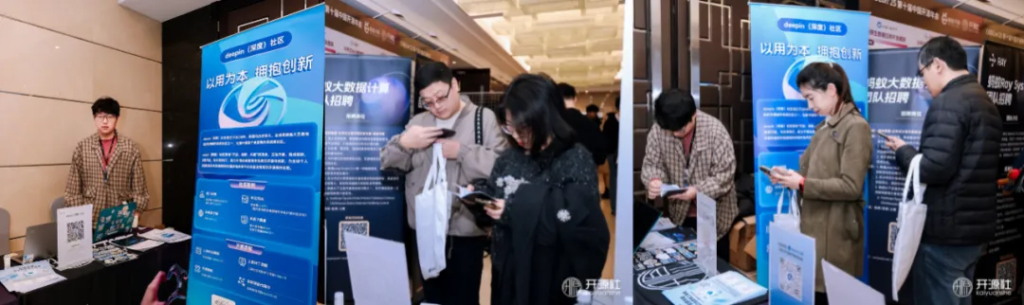
On December 6-7, the 10th China Open Source Conference (COSCon'25) was successfully held at the Legendale Hotel in Haidian District, Beijing. As an annual event that has witnessed the growth of open source in China since 2016, this year's conference brought together open source practitioners from around the globe. Among them, the deepin community presented its latest technological achievements and practical experiences in the field of intelligent operating systems. Through keynote speeches on core technologies and interactive exhibits, deepin demonstrated the path toward intelligent development for open source operating systems.
UOS AI: Reshaping the Intelligent Experience of Operating Systems
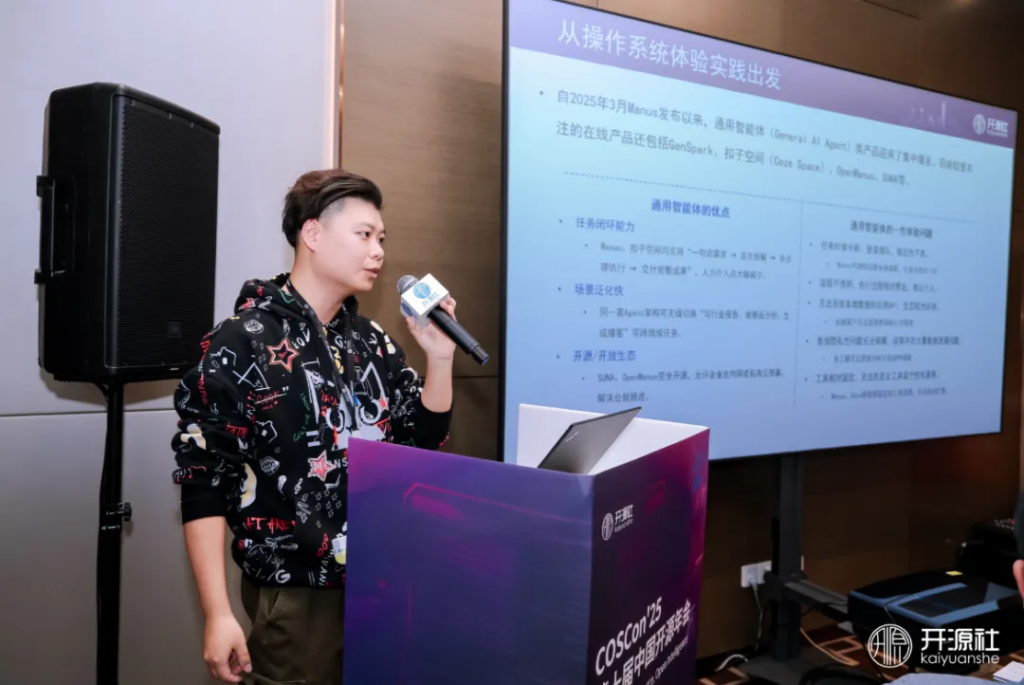
"Open source has become a core driver for innovation in operating system technology, and the integration of AI with open source is reshaping the industry landscape," stated Zheng Youge, deepin R&D Manager, during the "Open Source Operating Systems & Supply Chain Forum." As a seasoned expert in foundational software R&D, Zheng has years of experience at the intersection of operating systems and AI. He has been deeply involved in several national and provincial major science and technology projects, led the development of the industry standard "Linux Operating System Application Programming Interface Specification," and holds 11 related invention patents. His technical insights are highly regarded for their professionalism and practicality.
In his keynote speech titled "How UOS AI is Shaping a New Intelligent Experience for Operating Systems," Zheng Youge began with the UOS AI technical architecture, systematically analyzing its value in enhancing the end-to-end user experience of the operating system. He focused on explaining the application logic of cutting-edge technologies like deepresearch, memory, MCP (Model Context Protocol), and multimodal interaction. Live demonstrations vividly showcased technological breakthroughs—intelligent semantic understanding enables precise command responses, cross-scenario memory linkage improves operational continuity, multimodal interaction breaks down traditional operational barriers, and efficient task collaboration significantly boosts productivity. Attendees, primarily developers, took notes on key points and engaged in in-depth discussions about technical details after the session.
It is reported that the deepin community has achieved remarkable results in technological innovation and ecosystem building, experiencing leapfrog development in recent years. Technologically, relying on an open-source collaborative model, it has established a comprehensive R&D system, having contributed over 25 million lines of open source code in total. Its contributions to upstream communities continue to surge, with the deepin-wine project alone having over 100 high-quality patches accepted upstream. The core Desktop Environment (DDE) has been refactored with QML and adapted to major distributions like Debian, Ubuntu, Arch, and Fedora. Ecologically, the community has grown into China's largest and most active open source OS community. Its self-developed Linglong package format tool uses containerized sandboxing to break down ecosystem fragmentation barriers, allowing a single installation package to run seamlessly across multiple distributions. The App Store now offers over 100,000 software titles, comprehensively covering office, development, and entertainment needs. The community has established over 50 SIGs (Special Interest Groups), attracting a vast number of global developers to co-create. deepin now has over 8 million users across more than 100 countries and regions.